PASSAGE 1
You should spend about 20 minutes on Questions 1-14.
Thomas Harriot
The Discovery of Refraction
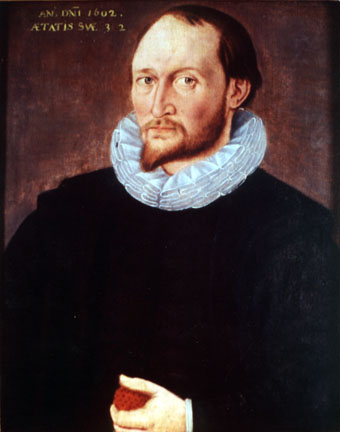
Thomas Harriot (1560-1621), English scientist and mathematician
When light travels from one medium to another, it generally bends, or refracts. The law of refraction gives us a way of predicting the amount of bending. Refraction has many applications in optics and technology. A lens uses refraction to form an image of an object for many different purposes, such as magnification. A prism uses refraction to form a spectrum of colors from an incident beam of light. Refraction also plays an important role in the formation of a mirage and other optical illusions. The law of refraction is also known as Snell's Law, named after Willobrord Snell, who discovered the law in 1621. Although Snell's sine law of refraction is now taught routinely in undergraduate courses, the quest for it spanned many centuries and involved many celebrated scientists. Perhaps the most interesting thing is that the first discovery of the sine law, made by the sixteenth-century English scientist Thomas Harriot (1560–1621), has been almost completely overlooked by physicists, despite much published material describing his contribution.
A contemporary of Shakespeare, Elizabeth I, Johannes Kepler and Galileo Galilei, Thomas Harriot (1560–1621) was an English scientist and mathematician. His principal biographer, J. W. Shirley, described him as 'England's most profound mathematician, most imaginative and methodical experimental scientist'. As a mathematician, he contributed to the development of algebra and introduced the symbols '>' and '<'. He also studied navigation and astronomy and was the first person in England to use a telescope for astronomical observations; later workers were able to compute the comet's orbit. Harriot was also the first to use a telescope to observe the heavens in England. He made sketches of the moon in 1609, and then developed lenses of increasing magnification. By April 1611, he had developed a lens with a magnification of 32. Between October 17, 1610 and February 26, 1612, he observed the moons of Jupiter, which had already been discovered by Galileo. While observing Jupiter's moons, he made a discovery of his own: sunspots, which he viewed 199 times between December 8, 1610 and January 18, 1613. These observations allowed him to figure out the sun's period of rotation.
Harriot was also an early English explorer of North America. He travelled to Virginia in 1585 as a scientific observer on a colonizing expedition. During his time there, he observed the land, plants and animals, produced drawings and maps, and learned aspects of the local native language. His findings were published as A Briefe and True Report of the New Found Land of Virginia in 1588. Raleigh gave Harriot his own estate in Ireland, and Harriot began a survey of Raleigh's Irish holdings. He also undertook a study of ballistics and ship design for Raleigh in advance of the Spanish Armada's arrival.
Harriot kept up correspondence with scientists in England and mainland Europe, particularly Johannes Kepler. Kepler had attempted to determine the law of refraction using flawed data from Ptolemy, which led only to approximate results. Although Harriot sent Kepler some refraction data, he did not supply enough detail, and Kepler eventually abandoned the correspondence due to frustration.
Apart from this correspondence, Harriot did not publish his findings on refraction. However, his personal notes reveal that he had discovered the sine law by at least 1602. He also conducted experiments on prisms, liquids and crystal spheres, and correctly explained the refraction involved in rainbows long before later scientists.
Most of Harriot's scientific work remained unpublished during his lifetime. The reasons are unclear, though poor health and fear of religious opposition may have played a role. For many years, Harriot was known only for his 1588 Virginia publication and a posthumous algebra treatise.
After Harriot's death in 1621, his manuscripts were lost until rediscovered in 1784. Although many remain unpublished, modern scholars have begun to appreciate the significance of his work. His contribution to the study of refraction is now increasingly recognized as a major achievement in the history of optics.
Questions 1-5
Choose the correct heading for paragraphs B-E and G from the list of headings below.
if the statement agrees with the information
if the statement contradicts the information
if there is no information on this
Paragraph B: Interests and research into multiple fields
Paragraph C: Expedition to the New World
Paragraph D: Correspondence with Kepler
Paragraph E: Unknown reasons for his unpublished works
Paragraph G: Belated appreciation of Harriot's contribution
Questions 6-14
Answer the questions below using NO MORE THAN THREE WORDS from the passage.
Thomas Harriot's Work
Discoveries and Contributions
- •One common use of refraction in lenses is for6
- •A beam of light can be separated into colors using7
- •In Virginia, Harriot mainly studied the land and native8
- •He later researched ballistics and9for one of his patrons
- •Harriot correctly explained refraction involved in the10
- •Harriot discovered11while observing Jupiter
- •Kepler used flawed data from12
- •Harriot's manuscripts were rediscovered in13
- •Snell discovered the law in14