PASSAGE 1
You should spend about 20 minutes on Questions 1-14.
Thomas More
A Man of Principle or Needless Martyr?
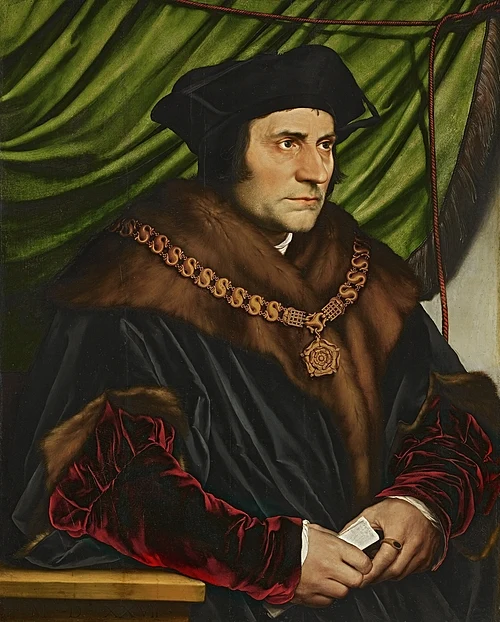
Sir Thomas More (1478-1535), English lawyer, philosopher, and statesman
Sir Thomas More was the most brilliant Englishman of his age in an age, the early Renaissance, which is thought to be particularly brilliant. He scaled the heights in law, in philosophy and literature, and attained high political rank as Chancellor. But the most challenging thing about this man is nothing that he achieved in life but the nature of his death. The facts are well known. He was executed by King Henry VIII in 1534 for refusing to accept Henry as head of the church in England. What is unclear is why he chose to refuse, and to die in this way.
Clouding the issue are the political and religious arguments which were at the root of his refusal and his death. It will be remembered that King Henry VIII was, for most of his life, an ardent Catholic who was awarded the title of Defender of the Faith for his resistance to the Protestant reformation. But his desperation for a male heir led Henry to divorce his first wife, Catherine of Aragon, in favor of the younger Ann Boleyn who offered the promise of a son. High politics among the crowned heads of Europe meant that this could only be achieved by a break with Rome and the acceptance of Protestantism in England. In a time when religion was taken very seriously by whole populations there was bound to be resistance.
Traditional Catholic writers, such as Friar Anthony Foley, have cast More as a martyr who stood up for the cause of Catholicism and perished for the true religion. 'More was a beacon of light in those dark times,' says Friar Foley, 'whose actions have shown the path of righteousness for true believers even down to the present day.' This interpretation was convenient for the Catholic Church, then as now, and resulted in More being made a saint. It ignores, however, the fact that More took every step to stop his ideas being made a political issue. Whatever reason he had it was not support of the Catholic Church. It also does not explain why More chose to take a stand, and effectively commit suicide, on this issue. Even under the teachings of the Catholic Church he could have sworn the necessary oath to Henry because he was under duress. The church in his day did not expect or require him to refuse. More's personal beliefs were his but refusal to take the oath is what condemned him.
A more recent biography, by Paul Hardy, views More as a medieval man and not the renaissance man he is often seen as. As such, Hardy argues, he would have been deeply conservative. The changes which Henry was embracing, with the acceptance of Protestantism, would have been highly offensive. 'As a lawyer and Chancellor, More had spent his life defending the status quo and now, at the stroke of a pen, it was turned round,' he writes. This rather ignores the deliberate modernity which imbued every other aspect of More's life from legal reform to the rewriting of school textbooks. Other writers, such as the psychotherapist Bill Blake, see More's demise as an example of depressive illness. Melancholy was widely known at the time but not seen as an illness. It is not implausible that under the strain of work and the profile of his position as Chancellor, he succumbed to depression and, desperate and indecisive, let death sweep over him. But contemporary reports are at odds with this. He made every effort to comfort and cheer up his own relatives and never appeared lost or undecided.
Since More himself left no explanation we will probably never really know what his motivation was. However, Hardy's observations are very true in some respects in that More lived in a very different world and one that is hard for us to understand. Life could be very cheap 500 years ago especially if one held high political office or intellectual views at odds with the establishment. There is no better way of appreciating this than to consider the fate of the poets in the Oxford Book of Sixteenth Century Verse. Two thirds of these poets died violent deaths, almost all at the hands of an executioner. With the possibility of death ever present it seems to have been regarded then with something less than the dread it evokes today. Perhaps this is what happened with More. After a lifetime of good fortune, considerable luxury and achievement, the wheel of fortune had turned, and he accepted his fate with good grace in the hope of an even better life in the hereafter.
Questions 1-14
Classify the following statements and answer multiple choice questions.
if the statement agrees with the information
if the statement contradicts the information
if there is no information on this
Blake: More was suffering from depression when he died.
Hardy: More was a traditionalist in his views.
The writer: More could have taken the oath and remained a Catholic.
Contemporary writers: More had a positive attitude to life and helped others.
Foley: More was defending the true faith.
The writer: More resigned himself to the fact that his good luck had changed.
The writer: More had a lifestyle which is difficult for modern man to comprehend.
Hardy: More showed he was a modern man in his restructuring of the law and education.
Which of the following was More NOT expert in? Answer: B - religion
Henry VIII executed More because: D - More refused to take an oath
More's death is a mystery because: B - he left no written explanation
Henry VIII broke from Rome because: C - he wanted to ensure the succession
The writer disbelieves traditional views of More's death because: B - More didn't follow Catholic teaching in refusing the oath
According to the writer, the life of an intellectual 500 years ago could be dangerous: C - if they held dissident views