PASSAGE 1
You should spend about 20 minutes on Questions 1-13.
Thomas Cole
The Course of Empire
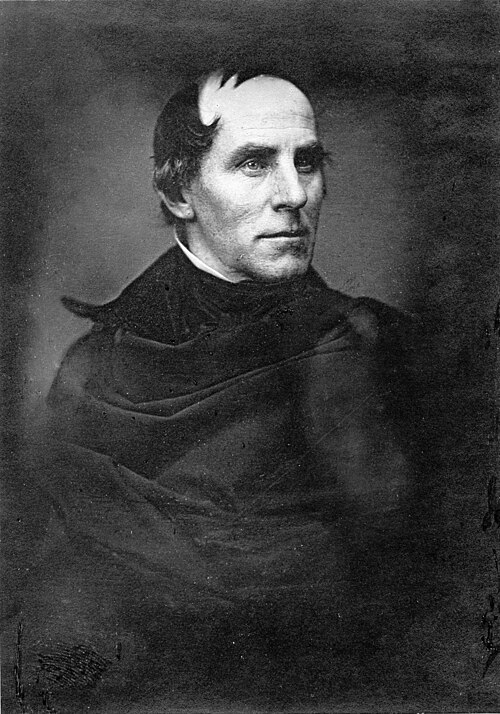
Thomas Cole (1801-1848), American landscape painter and founder of the Hudson River School
Thomas Cole (1801-1848) was America's first major landscape artist. Though he was born in England and spent his formative time in Europe, his identity was as an American nature painter. He was also an advocate and protector of untouched American land threatened by industrial development.
Cole's father, a small-time businessman, moved his family from place to place in northwestern England. In the process, Cole worked as a print shop apprentice, designing styles of cloth and later making reproductions of well-known paintings. In 1818, the family sailed to the United States, settling at first in the east coast city of Philadelphia. The teenage Cole stayed behind on the east coast as his parents traveled westward. From this point, his career as a largely self-taught artist began.
Cole began to travel and wherever he went - including, briefly, to the Caribbean - he sketched what he saw. He had little patience with cities and distanced himself from them when he could. At the Pennsylvania Academy of the Fine Arts, he became familiar with new American and European work. But within a few years, he felt ready to head to New York City, where he made lasting contacts in the still small art world, and was able to sell some paintings. And on an 1825 trip up the Hudson River, he found the subject that he would make his own: the American landscape, which he approached as both a mirror of reality and an object of fantasy.
Encouraged, Cole resolved to leave for Europe, a move that would let him see firsthand the art he had known mostly in reproduction. In terms of sales, London, the first stop, was a failure. No one noticed him, but he noticed a lot. He saw England suffering from chaos, with old social structures seriously breaking down as new industrial elite threatened a traditional wealthy rural class. And he saw artists responding to that. From England he went on to Italy, a more pleasant stay, though it was also suffering its own social issues. Outside Rome, he saw and painted countryside bathed in the hazy sunset light that he had seen and loved in 17th-century landscapes.
When Cole returned to America in 1832 he found it confusing and depressing. Though he had worked hard to leave his poor childhood behind through identification with cultural elite, Cole found a new America: competitive, commercial and uncivil, a land of uncontrolled and destructive greed. He was committed to the USA - he became a citizen in 1834 - but left New York City with his wife and children for the countryside. What most disturbed him was the government's seizure and destruction of natural forest lands. From his house he could see forests being rapidly cut down. Increasingly, he used painting to protest against these developments. Cole chose wilderness, and used the rest of his life to paint it.
One of Cole's earliest pieces illustrating his dedication to the preservation of nature is The Tree, dated 1823. Done while he was living in the Caribbean, it's an ink drawing of a single tree. But it is no ordinary tree: Although realistically drawn, it looks bizarre, almost resembling some kind of animal, swinging its arm-like branches and walking on its roots.
Cole's paintings from his Italian trip feature a different kind of countryside. These landscapes focused not on pure and untouched nature, but on the ruins of a long-dead culture. One of his most famous works is a series called The Course of Empire (1834-36). In five separate paintings, it narrates the stages that an unnamed fictional civilization passes through: from forest origins, to rural innocence, to proud flourishing high society, to destruction, to vanishing. Returning to America, Cole settled on producing and selling landscape paintings. An early landscape, View of the Round-Top (1827), depicts thin clouds in the cool fresh air, a forested mountain, and a river winding in the distance.
Questions 1-7
Do the following statements agree with the information given in Reading Passage? Write TRUE if the statement is true, FALSE if the statement is false, NOT GIVEN if the information is not given in the passage.
if the statement agrees with the information
if the statement contradicts the information
if there is no information on this
Thomas Cole was born in America.
Cole received formal training at an art academy.
The Course of Empire consists of five paintings.
Cole was concerned about industrialization in America.
Cole's paintings were immediately popular with critics.
The Hudson River School was founded by multiple artists.
Cole initially painted portraits before turning to landscapes.
Questions 8-13
Complete the notes below using NO MORE THAN TWO WORDS from the passage.
Thomas Cole's Work
The Course of Empire
- •The series shows civilization from8state to desolation
- •Paintings include depictions of9
- •The series shows different10of civilization
- •Cole found inspiration in11scenery
- •His work portrayed American12
- •Cole worked on13